Mastectomy - Simple, Modified Radical, and Radical
Simple
The incision is based on the need for reconstruction. This may involve a nipple-sparing mastectomy or skin-sparing mastectomy.
Creation of skin flaps
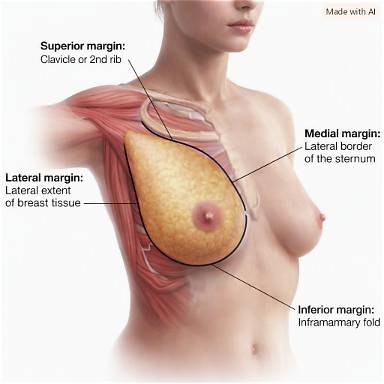
Skin flaps are raised superiorly to the clavicle, inferiorly to the superior aspect of the rectus sheath, medially to the sternal border, and laterally to the edge of the latissimus dorsi muscle.
Flap thickness should vary with patient body habitus but generally is approximately 7 to 8 mm.
The flaps are raised in the plane deep to the subcutaneous fat and superficial to the breast parenchyma, using scissors, scalpel, or electrocautery.
In the case of a nipple-sparing mastectomy, attention must be paid to spare the subcutaneous blood supply to the nipple when transecting the ducts and underlying breast parenchyma.
Identify and define the posterior, superior, inferior, medial, and lateral borders of the dissection.
Remove the breast tissue, including the pectoralis fascia.
Consider immediate reconstruction with plastic surgery if indicated.| - Autologous reconstruction commonly includes transverse rectus abdominis myocutaneous (TRAM), deep inferior (artery) epigastric perforator (DIEP), or latissimus dorsi flaps.| - Implant-based reconstruction includes tissue expanders or immediate implant insertion.
Generally, leave a negative pressure drain in place over the pectoral fascia.
Perform wound closure performed with absorbable sutures.
Modified Radical → above, plus level I & II axillary lymph node dissection.
Educational aid only. Verify every dose, indication, and guideline against current institutional protocol. This is not a substitute for clinical judgment.