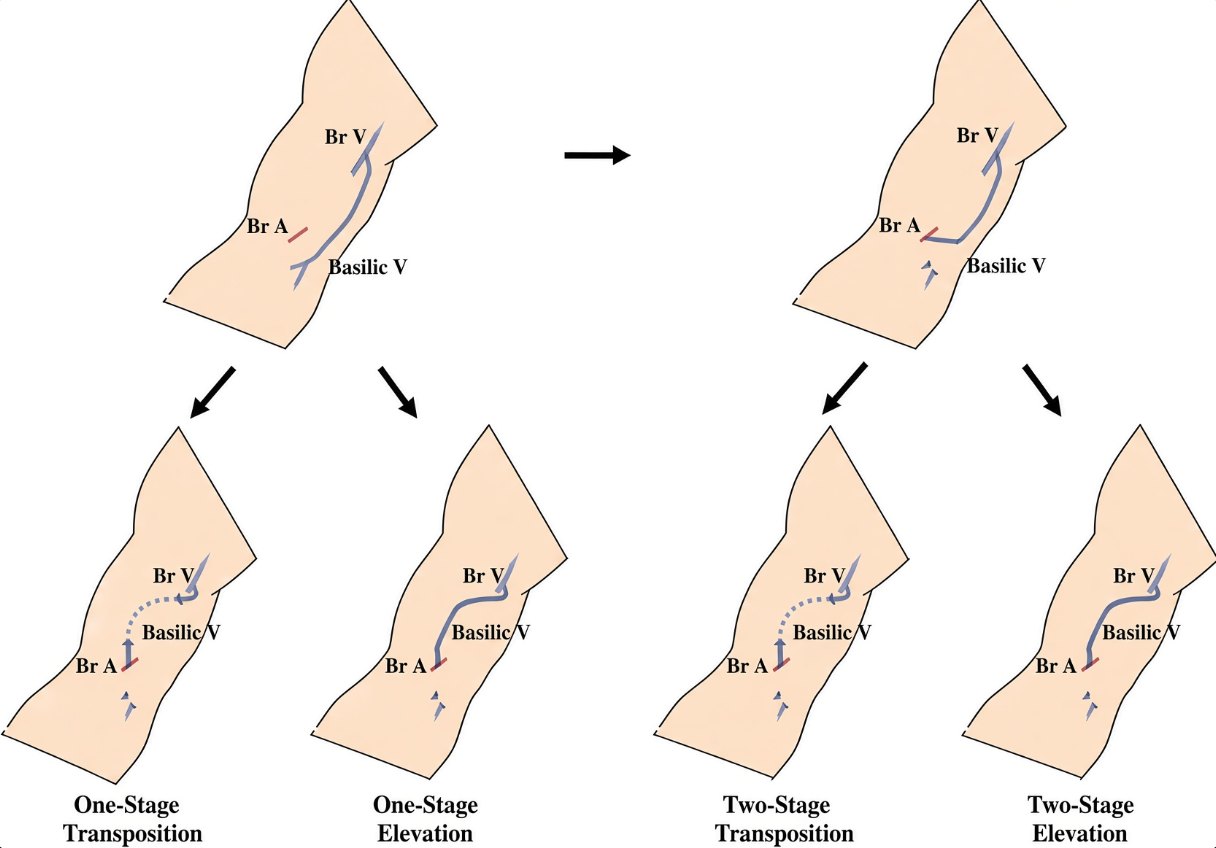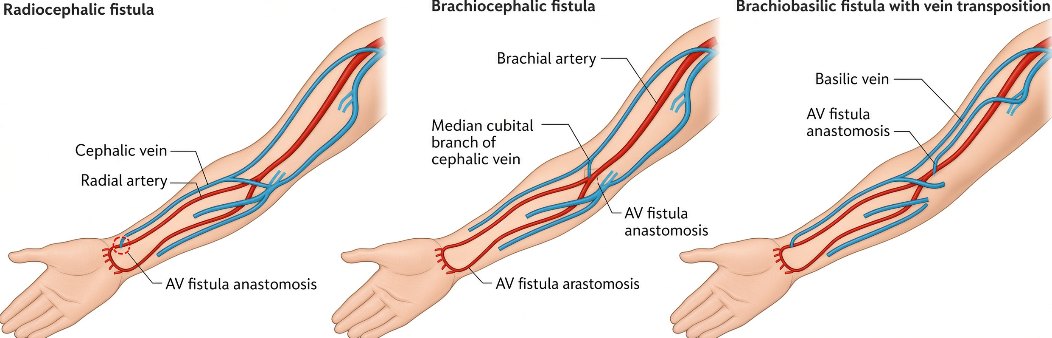
Arteriovenous Fistula
- The incision is tailored depending on the location of the vein relative to the artery.
- Sharp dissection is used to identify and dissect the cephalic vein. Any tributaries are ligated, and the vein is mobilized and secured with vessel loops.
- The radial artery is identified and mobilized proximally and distally for a 2-cm segment.
- The vein is then brought adjacent to the artery to lie without tension or kinking.
- Proximal and distal control of the artery is obtained, an anterolateral arteriotomy is made, and the artery is heparinized.
- An end-to-side anastomosis is formed by dividing the distal vein while maintaining proximal control and creating an arteriovenous anastomosis using 7-0 Prolene suture.
- A brachiocephalic AV fistula is made similarly, albeit more proximally along the arm, by making a skin incision over the antecubital fossa, exposing the cephalic vein and brachial artery, transecting the vein, and constructing the end-to-side anastomosis as described above.