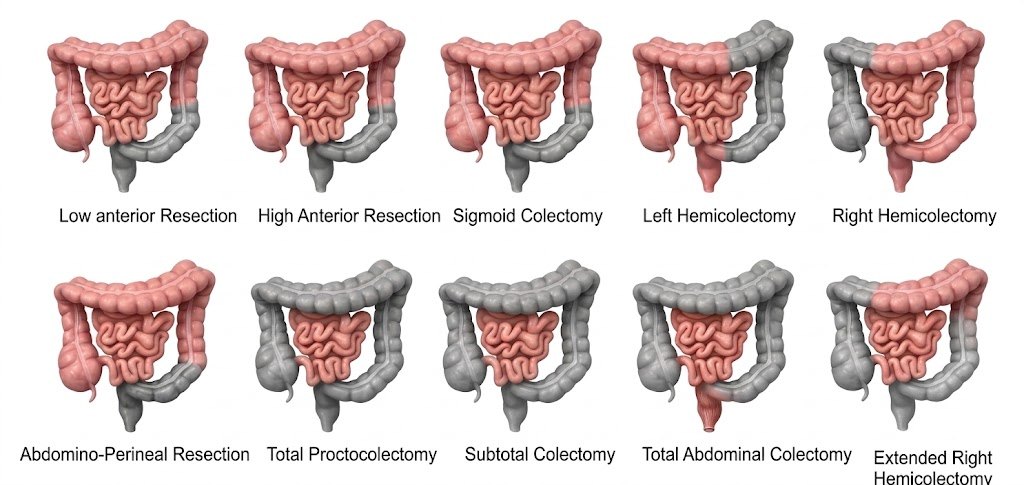
Subtotal colectomy is comprised of a TAC with ileostomy and preservation of the rectum or a total abdominal colectomy with IRA. A total abdominal colectomy with ileorectal anastomosis is more straightforward than a total proctocolectomy to perform and requires only one procedure. When comparing TAC with IRA to total proctocolectomy (TPC) with IPAA, there is a decreased risk of genitourinary dysfunction with less bowel frequency and soiling (2-4 bowel movements [BMs]/day), and a greater likelihood to maintain fecundity, but an increased lifetime risk (12%-29%) of developing cancer in retained rectum in patients with FAP.
Given a patient with fulminant colitis, appropriately place the patient in lithotomy position; gain safe entry into the abdomen; perform systematic exploration; safely mobilize the ascending, transverse, descending, and sigmoid colon; and create appropriate temporary diversion. Oncologic resection is not indicated in the absence of a neoplasm. Laparoscopic and open-surgery options are appropriate based on the surgeon's training and experience.
Given a patient with FAP, appropriately place the patient in the lithotomy position; safely mobilize the ascending, transverse, descending, sigmoid colon and rectum, and create appropriate temporary diversion. Oncologic resection is not indicated in the absence of a neoplasm. Laparoscopic and open-surgery options are appropriate based on the surgeon's training and experience except for patients with suspected or confirmed cancer, wherein an oncologic lymphadenectomy should be performed.
Given a patient with colonic inertia, appropriately place the patient in the lithotomy position; safely mobilize the ascending, transverse, descending, and sigmoid colon, and create a well-vascularized, tension-free ileorectal anastomosis. Oncologic lymphadenectomy is not indicated in colonic inertia and laparoscopic and open-surgery options are appropriate.
Educational aid only. Verify every dose, indication, and guideline against current institutional protocol. This is not a substitute for clinical judgment.